New blog

Thursday, November 29, 2012

Transparency in the ‘turbulent teens’


Being socially responsible is not only a matter of doing but also of communication: to show what you are doing, why and how. To inspire others, and also to offer room for stakeholders' ideas. The key word is transparency. Discover how transparency can help deal with the challenges of these times.


De Kristal
The Dutch Ministry of Economic Affairs, Agriculture and Innovation wants to encourage companies to be transparent about their sustainability activities. Good reporting is of crucial importance to separate the wheat from the chaff: how are the big companies doing and what types of improvements are there? Every year a selection of companies are evaluated on this in the Transparantiebenchmark. The winner receives the prestigious De Kristal award.


Turbulent teens
Social responsibility is here to stay, but what is really happening and, still more important: how effective is it? These are turbulent times because the world is on the move. Different problems are addressed in the report Vision 2050: the new agenda for businesses: unemployment and social unrest such as e.g. happening in South Europe; climate changes and scarcity of raw materials. We are only at the beginning of a difficult road: ‘The turbulent teens have just started.’ Therefore we need a radical, fast reformation, namely NOW.


Accountants to the rescue
Revolution does not occur automatically; we must actively work on it by creating the right frameworks. ‘We must change the rules of the game’, says Peter Bakker of the World Business Council for Sustainable Development (WBCSD). Meaning: companies must pay for the natural and social consequences of their activities. It is time to draw up rules for non-financial reporting (for natural capital and social capital), only then will real transparency emerge. A good example for this is Puma: they map the Cost of the Planet of their company’s activities.  

Your true nature
On the 22nd of November three companies received De Kristal 2012 award. Mondial Movers was chosen for the second time in a row in the category SME, while DSM was the big winner among the large companies. Koninklijke Wessanen won the award in the category ‘biggest improver 2012’.
The jury had chosen the credo ‘Show who you really are, what your true nature is’ in order to select the winner. This may be the golden tip for those who want to go for next year’s award.

Wednesday, November 21, 2012

City farming

There are more than 7 billion people on earth. Every second 5 people are born and 2 pass away. Therefore, the world population continues to grow and all these people must be fed. At the same time, an urbanization process is taking place: in 2012 approximately 47% of all people live in urbanized areas and that percentage will only grow. Cities are not known as places where food is grown, however that may possibly change: cityfarming is emerging!

No fertilizer and little water
Ryan Griffis, Wikimedia Commons 
'Cities cover only 2% of the Earth's surface, but consume 75% of its resources. Cities are black holes, they're swallowing our planet. But, more and more, they're turning green’, says Jac Smit, the author of Urban Agriculture: Food, Jobs and Sustainable Cities. A good example of this development is the initiative that Eric Maunda took in West-Oakland. Eric lives in a typical concrete jungle with little green and a lot of asphalt. However, he does not see an obstacle there because he uses aquaponics, a sustainable eco system for the production of food. A combination of raising fish and plants in a circulating system: the fishes' waste is used as nutrients for the plants. No fertilizer is used and the water does not have to be cleaned all the time: up to 90 %(!) less water is used with respect to traditional agriculture.

Endless possibilities
Dezsery (Wikimedia Commons)
Green initiatives are also being developed in Asia, where the population is growing fast. In Hong Kong there are different farms which have found a place on top of sky high apartment buildings. They grow lettuce, spinach, apples, carrots and everything else that comes to mind: the possibilities are endless!
Even in Africa people have started urban farming, in places such as Nairobi, Kampala, and Dakar. The advantages are huge and it concerns more than only food: ‘These projects are not only helping to provide fresh sources of food for city dwellers, but they also provide a source of income, a tool to empower women, and a means of protecting the environment, among other benefits’, says May Njenga, researcher at the University of Nairobi.


Bryghtknyght, Wikimedia Commons. 
We all need food
No matter who we are or where we come from: we all need food. However, it is a fact that the raw materials are getting scarce and food prices continue to rise. Therefore, we need new methods to provide food for ourselves. City farming can greatly contribute to this endeavour.

Thursday, November 15, 2012

Sustainable dating

Sustainability is a popular term. Many entrepreneurs feel a connection with their surroundings and 'want to do something'. Continuously new large- and small-scale initiatives are developed, but these actions are mainly internally focused. That is a shame, because joining forces with other organizations provide enormous added value. But how do you start?

Tasty setting
Twice a year in the Dutch city Eindhoven forces are working together to connect companies, schools, social and governmental organisations who are involved with their local environment. Well, ‘working’… the highlight of the ‘Sustainability 040’ *) is a nice diner. In a cosy setting contacts are easily made. The purpose of this particular evening: to create partnerships to ensure people with a distance to the labour market are provided with new opportunities, for example by offering internships or providing workshops.

It is not about money
We don’t have to invent the wheel again. Companies must do what they are doing already and should stick to their core business. A law firm provides legal services; a newspaper provides publicity, but for free. It is specifically not about money, but about sponsoring with knowledge and resources.


70 matches
The wonderful thing about ‘Sustainability 040’ is that matches between organisations are made quickly. No big projects, but action! During the last event on 6 November 2012 44 organisations were present, which resulted in no less than 70 (!) matches. Some of the agreements made:
* A well-known hospitality chain is offering internships. 
* Women in local woman’s shelters are provided legal support by a law firm.
* A local recruitment agency is going to recruit new volunteers for the local support-service (Vrijwillige Hulpdienst) in Eindhoven.
* DressforSuccess is going to make sure newcomers are adequately dressed for a job interview.
* Local hospitality companies will help provide the traditional Christmas diner to the Salvation Army.

Who is next?
It is probably clear: sustainable dating is tasty, cosy and leads to quick success. Who is next?

*) ‘Sustainability 040’ (in Dutch: Duurzaam Ondernemen 040) is an initiative of the municipality of Eindhoven and De Lage Landen. 040 is the city access code for calling to Eindhoven.

Wednesday, November 7, 2012

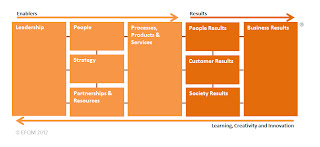
Update EFQM Excellence Model

'Nothing lasts except change' (Heraclitus).
The world is changing, so the EFQM Excellence Model changes along. We are living in a world where changes happen in quick succession, so 2010's last update needed evaluation. Please meet the EFQM Excellence Model 2013.

Basic Principles
The EFQM Excellence Model is based on a set of European standards, originating from the European Convention on Human Rights (1953) and the European Social Charter (revised in 1996). Then 10 base standards were set in the European Global Compact, which are indicators of 'sustainable and socially responsible business' (2000). More than 30,000 organizations all over the world, so not just European institutions, embraced the EFQM Excellence Model through the years.

No Revolution
This update should be considered an adjustment of the existing model, and is therefore an evolution and not a revolution. The structure and terminology have been adjusted if necessary, but the foundation keeps standing. This base consists of 'Fundamental Concepts of Excellence', which describe the characteristics of a sustainable, excellent organization. The 'Model' is where these standards are converted to actions. Last but not least, it contains the 'RADAR', a management tool that shows the status of the organization: what changes (still) have to be implemented to achieve excellence?

 Adaptability
The new model pays more attention to, for one, the flexible and powerful response to changing conditions. These are dynamic days we are living in, and a company's adaptability becomes increasingly more important.
This update also pays more attention to the higher importance of social media. Research agency Millward Brown concluded that European managers consider social media a condition for expansion. It becomes more valuable every day, and this is actually a global phenomenon: social media also keeps developing in Asia, America and the Middle East, both on the quantitative as the qualitative area. 
 
Proactive
The EFQM Excellence Model 2013 is already available in different languages in EFQM's webshop. The new Model will be rolled out worldwide in November 2012. Be proactive and meet THE new standard for a more sustainable world. 

Wednesday, October 31, 2012

A view on the future

From 20 to 28 October, the largest designer event of the Netherlands took place in Eindhoven: the Dutch Design Week. A large-scale international event where 1800 designers, spread over 85 locations, made their appearance. A mere 180,000 visitors from all over Europe visited the DDW and drew inspiration from it. The DDW proves that sustainability and efficiency make a perfect combination with beautiful design.

Practical Palm Leaf
The PalmLeatherSandals project was one of the Green Design Competition winners, and therefore DDW's eye-catcher. The idea: sustainable flip-flops, made of palm leaf. A well-considered concept according to the jury: 'In an enormous market, plastic is being replaced by biodegradable materials. Moreover, the product is so well-designed that people won't throw it away that easily.'


Edible Insects
The other The Green Design Competition winner was titled Entoa roadmap to edible insectsEnto anticipated to the worldwide increase demand for food. The jury applauded the project with the following words: 'This concept can have a major effect on Western people's diet. The design and branding create the potential to reach a large group of people at the same time.' 
         
Source: www.cargocollective.com


Dynamic Coffee Bar
The Noorderparkbar was established in Amsterdam this March, located in the park with the same name. A modern coffee bar that looks brand-new, but is only made of second-hand building materials made available by private persons and small merchants. An online marketplace turned out to be the perfect spot to purchase materials.  Because the online offer changes every day, it was impossible to determine what the bar would look like in advance. The design was changed to the materials they could buy throughout the entire process.

  Source: www.raamfolies.nl


Creative Chimaera
The Dutch Design Week presents an attractive melting pot of creative chimaera every year. Surprise and amazement are always on the look-out, regardless of this being an industrial or spatial design, textile or architecture. 'Sustainability' clearly managed to secure a position in the design landscape. Or, as the organization states: 'Designing with sustainability in the back of your mind is the future.'

Wednesday, October 24, 2012


Get into action!

It starts with awareness. Change is impossible without understanding the relevance and possibilities of sustainable management. The practical conversion takes place after the awareness; how will you implement sustainability? Where do you start? What means do you deploy and how do you create a basis?

Fundamental
The basis of the 'sustainability' subject is getting wider for companies in the Netherlands, as proves research by the BZW (Brabants-Zeeuwse Werkgeversvereniging). Sustainable management is in the top 3 of many priority lists, but how do you take care of it? Incorporating sustainability always means change management, it is therefore fundamental and mostly leads to a hesitant start. This is where we come across the first pitfall; endless talks, discussions and thinking without making concrete steps. It is better to just get into action and start the process.


Improvements & Savings
Those who know their company processes, also know what their impact is on the environment; what raw materials and resources are used and how much waste they create. Make 'more efficient working' a main goal. This often leads to quick process improvements and savings, which motivate you to continue. Expand your knowledge of sustainability, and you will soon notice new areas for improvement. A positive cycle in the right direction has been created.

Embedding
There is no standard blueprint that paves the way towards sustainability. There are a number of logic steps though, and implementing structure is the first one. Set goals, work on certification and consult with customers. Make this a policy and give your staff members the space to make their own creative contributions. The entire organization is to embrace sustainability; it has to be embedded in the 'hearts and minds'...
 
Inspiration & Motivation
In contrast to what most people think, sustainability is not something large departments necessarily have to implement. Just take a look at ASML, one of the world's most sustainable companies. A company with a 5.7 billion Euro turnover (2011) that made the conscious choice to take its responsibility for both the social and environmental part. A team of only 4 part-time staff members started mapping sustainability
Not by enforcing it top down, but by inspiring, motivating and securing. Sustainability is given a practical interpretation at the departments of the company itself, for example by working with an environment management system (ISO 14001).
It is clear: sustainability does not have to be unnecessarily difficult. It is just a matter of choosing and doing.

Wednesday, October 17, 2012


Go with the flow or stay behind

The EFQM Forum 2012 was organized last October 9 and 10. Under the name 'Fit for the Future', the challenges and chances that await us over the next 20 years were discussed. We are living in a dynamic, changing world where both raw materials and time are scarce, so how do we deal with that? How do we create excellence for our organization?

New base
On behalf of the European Commission, Reinhard Buescher had a shot: 'There is no easy solution available for the current crisis. We need a new industrial base in Europe, a strong, sustainable and solid one. Mainly technological innovations enable us to structurally change society.'
Futurologist Peter Cochrane even heighted this: 'We cannot get any smarter or work harder from a biological perspective, we have reached our max.' Luckily, he was there to offer a solution as well: 'Technology can help us save the world.' A beautiful example of such innovation is the 3D printer. We can already use them for medical goals.


Flexible life
‘Research proved that 92% of all creative work-related ideas are invented outside the office', as says Marc Buellens (Professor of the Vlerick Leuven Gent Business School). The mind is flexible and needs a flexible organization. Or: it's finally time for 'The New World of Work'. Finally indeed, because not much has changed since its introduction in 1954 (Peter Drucker - Management by objectives), not counting the small number of exceptions.
But in the year 2012, we live in a time where smartphones, tablets and laptops have become common property. We live in a global village, can work everywhere and it's therefore unnecessary to join the traffic jams every day. Moreover, employees don't see the point of it, generation Y leading the pack. This generation – that first thinks of a virtual meeting place when they hear the term 'social network' – is exceedingly suitable for flexible forms of labour based on autonomy and own responsibility.           

Remarkable results
The Belgian Mobistar has now embraced The New World of Work, as became clear at the Work@Home,Home@Work Bbest Conference at October 8 2012. A large part of the staff was offered the chance to (partially) work from their own homes. Of course a number of rules was set, but there was more than enough space for one's own initiative within these rules. This lead to more motivation, less 'traffic jam distress' and a better 'work-life balance'. The results were also positive to Mobistar: there was a significant improvement of both productivity and cost efficiency.

Network society
Regardless of being an employer or employee: it's time to open your eyes. Only 5 years ago, Twitter and Facebook were still relatively unknown. In 2009, only 10% of the Dutch inhabitants had a smartphone, in the year 2012 over 60%. In only 2 years, the knowledge recorded on the web will double every eleven hours(!). A network society based on premium technology is the future. It is just a matter of going with the flow, or staying behind...