New blog

Showing posts with label EFQM. Show all posts

Wednesday, March 13, 2013

Practicing sustainability difficult? Of course not!

Often there is a world of difference between theory and practice. How to make the transition from model to reality? How to implement a sustainability strategy? When using the EFQM Excellence Model that is not so difficult.

Sustainability
From the very beginning the EFQM network felt ‘society’ needed to be one of stakeholders in the EFQM Excellence Model. And as a result the interests of the public at large have always been part of the values underpinning the criteria of the model. These values, there are eight, are called the Fundamental Concepts of Excellence. In the 2013 revision of the model the ‘society concept’ is titled: "Creating a Sustainable Future".


Good management
The EFQM network always considered the EFQM Excellence Model to be a 'sustainable model'. Implicitly, but also explicitly, society is part of the EFQM model criteria and sub-criteria. And during more recent evaluations of the EFQM Excellence Model 'having a positive impact on society’ has become even more apparent as one of the principles of ‘good management’ according to the EFQM.

Illustration: Ivo van Leeuwen.
 Supply chain
To create a sustainable balance between the interests of companies, people and the environment (people, planet, profit) strategic focus should be directed towards international socially responsible supply chain management. This supply chain approach is also the point of attention in the debate on transitioning from a linear economy to a circular economy, going from ‘take-make-waste' to 'borrow-use-return'. All this goes far and beyond the realized positive or negative impact of the company itself.

Golden combination
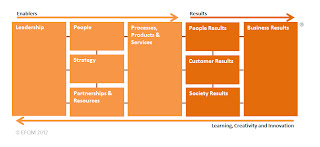
Using The Natural Step Framework an organization develops a sustainability strategy with the planet as one of the stakeholders. With the EFQM Excellence Model, consisting of the Fundamental Concepts, the nine criteria of the EFQM Model and RADAR, this sustainability strategy can be implemented. Using the EFQM Excellence Model an organization can develop a culture of excellence, bring consistency in the management style, compare themselves to the good examples of others and encourage innovation to improve results. The Natural Step and the EFQM Excellence Model are therefore sustainability’s golden combination.

Wednesday, November 7, 2012

Update EFQM Excellence Model

'Nothing lasts except change' (Heraclitus).
The world is changing, so the EFQM Excellence Model changes along. We are living in a world where changes happen in quick succession, so 2010's last update needed evaluation. Please meet the EFQM Excellence Model 2013.

Basic Principles
The EFQM Excellence Model is based on a set of European standards, originating from the European Convention on Human Rights (1953) and the European Social Charter (revised in 1996). Then 10 base standards were set in the European Global Compact, which are indicators of 'sustainable and socially responsible business' (2000). More than 30,000 organizations all over the world, so not just European institutions, embraced the EFQM Excellence Model through the years.

No Revolution
This update should be considered an adjustment of the existing model, and is therefore an evolution and not a revolution. The structure and terminology have been adjusted if necessary, but the foundation keeps standing. This base consists of 'Fundamental Concepts of Excellence', which describe the characteristics of a sustainable, excellent organization. The 'Model' is where these standards are converted to actions. Last but not least, it contains the 'RADAR', a management tool that shows the status of the organization: what changes (still) have to be implemented to achieve excellence?

 Adaptability
The new model pays more attention to, for one, the flexible and powerful response to changing conditions. These are dynamic days we are living in, and a company's adaptability becomes increasingly more important.
This update also pays more attention to the higher importance of social media. Research agency Millward Brown concluded that European managers consider social media a condition for expansion. It becomes more valuable every day, and this is actually a global phenomenon: social media also keeps developing in Asia, America and the Middle East, both on the quantitative as the qualitative area. 
 
Proactive
The EFQM Excellence Model 2013 is already available in different languages in EFQM's webshop. The new Model will be rolled out worldwide in November 2012. Be proactive and meet THE new standard for a more sustainable world. 

Monday, February 28, 2011

EAT in Abu Dhabi!


In January I visited the Middle East for the first time in my life. Everywhere in Europe it was snowy and cold, but I traveled to the best of climates: warm and sunny about 25 degrees Celsius. Just perfect! As a member of the EFQM faculty of trainers I was requested to visit Abu Dhabi and to support the new partner there with introducing the assessed-version of the EFQM Assessor Training course. This partner is the Sheikh Khalifa Excellence Award (SKEA) organisation and is the latest addition to local partnerships of the EFQM in the Middle East.
SKEA has been running the local excellence award program in Abu Dhabi for some years now. Although it has been running successfully they wanted to take their award program to the next level. From the beginning the program has been based on the EFQM Excellence Model and the assessment procedures have been similar to those of the EFQM Excellence Award. This includes an award ceremony concluding the cycle for the year. During the ceremony the Sheikh personally gives out a Diamond, a Gold and a Silver Award to the organisations that proved to be the best in Abu Dhabi. The next level for SKEA means running the award program based on the EFQM 2010 Model and the next SKEA award cycle will be based on it. After the summer the 2011 award assessments will take place and for the members of the Abu Dhabi assessor pool to be ready they are provided with additional EFQM Assessor Training. 
I was very happy to support the local trainers, Hadi Eltigani and Tony Bendell, with training the first group of local assessors according to the assessed version of the EFQM Assessor Training course. The people selected and asked to participate in the first course are considered to be the best-of-the-best of the assessor pool in Abu Dhabi and without exception this proved to be true. They evidenced to be skilled in performing assessment procedures and were eager to learn about the EFQM way of working during the training course. This has been my most enjoyable EAT course so far. I have made some great new friends and I wish Waheeda, Doaa, Aline, Abdulqadar, Grant, Srijayan, Kanak, Rachid and Mahmoud good luck and good fun with their next award assessment job! 

Tuesday, December 28, 2010

What is the most important Fundamental Concept of Excellence?


The LinkedIn-debate on this question I started a few weeks ago among the members of the EFQM Network for Sustainable Excellence has really taken off! However some more debate is needed…
As mentioned in my earlier blog the EFQM states no preference, but to get the discussion going I argued that Taking Responsibility for a Sustainable Future is the most important Fundamental Concept of Excellence.
A variety of views have been shared by the members in this discussion group and have included:
  • Nice “academic question sparking debate”, however there is no most important Concept, but an organisation needs to take care of all Concepts to achieve sustainable results;
  • Depending on the organisation’s goals, vision and strategic challenges at a specific point in time an organisation might need to give two or three Concepts more attention;
  • That business survival is key and as a consequence Adding Value for Customers and Achieving Balanced Results are the most important Concepts;
  • Things don’t move forward without leaders Leading with Vision, Inspiration and Integrity first;
  • Organisations are made up of people, little happens without them, so Succeeding through People needs priority.


I was particularly struck by an interesting comparative question: “What is the most important room in the house?” For me it is the bathroom, but it was a difficult choice as I have a number of rooms to choose from. However there are many people in this world that don’t have a choice in this matter. 

With proposing the Concept Taking Responsibility for a Sustainable Future to be the most important I aimed to direct the discussion towards taking a more global perspective. To discuss maybe whether our current way of moving forward with an "inside-out focus" on the needs and expectations of the stakeholders will help us to address the global ecological and societal challenges lying on our doorstep? Would even an organisation striving for Sustainable Excellence take a wide enough view towards “all their stakeholders”? We perhaps need some debate on this topic?

Friday, November 26, 2010

EFQM Ambassadors

As a member of the EFQM Faculty of Trainers I regularly have the pleasure to train a group of people who have applied to become EFQM Assessors. Again I had this pleasure last week, when I worked together with my fellow faculty member Chris Hakes.
Being an assessor is a demanding task and it requires a specific set of skills and competencies to be successful. That is why the EFQM Assessor Training (EAT) is a pass or fail training. Prior to the training participants are asked to analyse a case study. Completion of this case study exercise is a pre-requisite for taking the training. The ‘open registry’ trainings are delivered in Brussels at the EFQM premises. The training takes three days and people who pass are qualified to participate in an international EFQM Excellence Award Assessment. 
The assessor training is an intense event. During the open EAT you will normally work together with a diverse group of people who you have not met before, as you would during an assessment. The training group last week was again wonderfully diverse. People came from all over Europe and from various types of organisations to receive their training in Brussels.


During the training we go through the steps in the assessment process supported by the completion of several practical individual and team exercises. Participants are explained how to use the EFQM Model and RADAR in the context of executing an effective assessment of an organisation.
Ultimately Chris and myself have again been able to deliver new additions to the EFQM pool of assessors. The participants left the training content. Now they understand more about the EFQM Model and the benefits of applying it, not only for assessment purposes, but also as a tool for management for running and improving their business.
But apart from that I feel the EAT might also have turned them into new EFQM Ambassadors, as it turned me into one several years ago!

Wednesday, November 24, 2010

PBE

In 2006 when the deployment of the EFQM Excellence Model had been on the way for some time in Philips a new training course was developed. Although in-house assessor training had been provided to many managers throughout Philips over the years, the company identified that specifically RADAR-thinking provided the biggest added value to its managers in their day-to-day working environment. This resulted in the development of a training to teach managers in Philips to use this tool directly on processes. The training consisted of two courses. The first course was called the Philips Business Excellence Course 1 Introduction, a half a day introduction into Excellence, the Concept and the Model. The second course was the Philips Business Excellence Course 2 Calibration, a full day workshop to practice to apply RADAR directly on processes with help of a few case study assignments. The aim was to ‘quickly’ provide Philips managers with an easy and practical tool to help them to look at and review the processes in their own organisation in a structured way.
Specifically Philips Research has been providing these training courses to its managers for these many years. However as the EFQM Excellence Model was updated last year, so were the PBE-training materials in need of an update. On request of Philips Research I updated the training materials and provided the first ‘EFQM Model 2010 proof’ PBE-training courses to a group of managers from Philips Research at the beginning of this month. It was an inspiring and successful training as the participants concluded that RADAR is a practical tool to review their business processes and identify areas for improvement. One participant commented that he had wished he had known about this tool already years ago! I am very happy that the workshop was a success and I am already looking forward to providing the next PBE-training courses!

Wednesday, October 13, 2010

Just start!

It is time for me to start blogging. I have been thinking about how to start this blog for a long time now, considered several options and I have come to the conclusion it is best just to start with it! But before I do I need to clear up a few things.
First of all I will write in English and not, for instance, in Dutch, which is my mother tongue. The reason is that many of my friends and contacts speak other languages than Dutch and I want to communicate to “a big audience” so writing in English will be the best approach to take for my blog.
Secondly I expect mostly to write about excellence in a business context, meaning: to continuously improve the organisation to get better results.  Before long you will notice that I will refer to the EFQM and the EFQM Excellence Model often. For those among you that do not exactly know who or what this is can take a look at a good article in the online magazine of  Achieving Business Excellence October 2010.
Suspect that you will ask yourself “why” now. If you have read the article you know now, that the EFQM Model is not “new” as it has been around for 20 years. Personally I came in contact with the Model a little over 10 years ago, when I was still working for Philips. Since my first contact with the Model in Philips I have become more and more involved and interested in Business Excellence. Up to the point where I decided to put my long Corporate career in Finance at Philips to rest and put all my time and energy in helping organisations to improve.
Some insiders might refer to this state as “being bit by the Excellence bug”... Well, I know I have been bitten. I fully believe in the benefits of using the EFQM Model to improve your status quo and to get better and more balanced results, whatever results your organisation is aiming for.
However, the Model is not for wimps! One does need to put their teeth in it, as it will take some time, maybe years, to improve your results in a sustainable way. But this should not come as a surprise, good things hardly come easy! My advice is: just start! CU later!