New blog

Wednesday, December 19, 2012

From past to future

The Roman Emperor Marcus Aurelius already knew: ‘Time is a sort of river of passing events, and strong is its current’. The year 2012 is already coming to an end and it is time to take stock: which sustainability successes can we show? What does this mean for next year? A bird’s eye view.

Energy-efficient
In 2012 Improve4all provided sustainability support for the business of chip machine producer ASML: the Sustainability Report 2011 was successfully completed. Eric Meurice, President and Chief Executive Officer van ASML: ‘We see it as our mission to develop machines that manufacture more efficiently integrated circuits, which themselves will enable more energy-efficient electronic products. Our sustainability strategy goes hand in hand with our business strategy.’

EFQM-training
Working together on creative & inspiring solutions,
to improve us all.
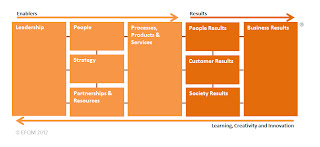
An excellent organisation requires an excellent approach. During the year Improve4all, as member of the faculty of trainers, provided various EFQM-training courses around the world. At the EFQM offices in Brussels, but also on location in Abu Dhabi for instance, managers were trained in ‘the excellence practices’: how do you determine if a business is organising its people and processes in an optimal way? How does an organisation make sure that their business results are balanced with their customer results, employee results and society results? And which part are leaders playing here?

Zero Impact Growth
The journey towards a sustainable world is not an individual journey, many, and each in their own way, work at making the world a better place. Some are very inspiring. Take John Elkington who, in his book The Zeronauts – Breaking the Sustainability Barrier, set the new standard for sustainability this year. The idea is: the world is confronted with some enormous challenges, better known as the 5 P’s: population growth, pandemics, poverty, pollution, and proliferation. The only remedy for a healthy future is to place our bets on an economy that grows without any negative impact on the planet. In short: Zero Impact Growth.

Plans for 2013
This is only a fraction of all beautiful experiences of the past year. In 2013 this path will partly be continued: several training courses and assessments are on the agenda, and for ASML the completion and publication of the Sustainability Report 2012 is on there too. Next to this some new developments can be reported: Improve4all will extend the European base (run from The Netherlands) and also set up a hub in the Middle-East. Since the capacity will be enlarged there will be room for new initiatives. So please feel free to spar and brainstorm, who knows this might lead to sustainable insights …

Firm base
Improve4all is working on their next steps with the deeply rooted belief that truly excellent organisations make the world a better place. By inspiring leaders to find innovative and sustainable solutions for their organisations Improve4all stimulates organisations to achieve and sustain outstanding levels of performance. That is why, in 2013, we will strongly focus on sustainable excellence again.

But until that time Improve4all wishes you a Merry Christmas and a Happy and Healthy New Year!

Thursday, December 13, 2012

How world leaders deal with global problems

According to the famous list of Forbes Magazine Barack Obama and Angela Merkel are the two most powerful people on earth. So, a man and a woman, each with their own distinctive leadership style. How did they deal with the global problems they encountered?

Sleepless nights
To the European Union the situation in Greece was thé nightmare of 2012. How to deal with a country that is economically véry fragile, but politically and economically so entangled with the rest of Europe? The first support package was easily crafted, but when that was not enough, views differed: devaluate debts or still a ‘Grexit’. Already in 2011 specifically British Prime Minister Cameron reacted fiercely: ‘Not one penny more. British taxpayers' money won’t be spent on another Greek bailout.’ Also Angela Merkel spoke firmly, but with a different view: the Greek should economize, and not just a little bit. For ‘us’, but mainly for themselves. This did not make her very popular in Greece. Understandable when people see their pensions go up in smoke, but not entirely justified: Merkel has continued to believe in a future for the Greek in Europe. Even in the prospect of having to devaluate the debts.

President Barack Obama talks with German Chancellor
Angela Merkel and British Prime Minister David Cameron
(Wikimedia Commons; Official White House Photo; Pete Souza).


Gusto
Barack Obama has ended a very thrilling election period. At first it seemed to be a walkover, but after the television debate it became a very close race with Mitt Romney. In the heat of the electoral fights hurricane Sandy through herself into the ring, with disastrous consequences. Obama immediately put the federal government in action, paused his campaign and sent in many people to provide support. On the other hand Romney was of the opinion that the government should be holding back and let the states take the lead themselves. Obama’s gusto and humane response were praised everywhere and got him many new voters.  Interesting detail: according to Obama himself it was due to the female voters that he was re-elected (‘It was women wot won the election’)…


Confront problems
True leaders have a sharp strategic insight, do not walk away from trouble, can release themselves from existing structure and are capable to make compromises. Having gusto and being authoritarian are not synonymous: big leaders above all are humane.

Women cheer in front of Trinity College, Dublin, as United States 
President Barack Obama and First Lady Michelle Obama are introduced 
to a large crowd before an address by the President at College Green in 
Dublin, Ireland, 23 May 2011 (Wikimedia Commons; 
Official White House Photo; Pete Souza).


Wednesday, December 5, 2012

Why we need female leaders

Anyone to google ‘sustainability’ is treated to millions of hits. There is a vast amount of information available on innovative, inspiring and intriguing ideas that make the world a bit better. From wild futuristic plans to small-scale initiatives that distinguish themselves because of their simplicity. But how are ideas transformed to reality? That is where you need leadership. Sounds logical, yes? However, what is leadership anyway? And who are better at it: men or women?

Share and support
U.S. National Archives and Records
(Administration Wikimedia Commons)
To analyse ‘leadership’ Google also provides good results. Many sites speak of leadership styles, ranging from situational, servant, personal, empathic or even invisible leadership. Many roads lead to Rome, but a clear vision, creativity and vigour are recurring features. This also holds true for integrating sustainability in organisations: without a strong message it will lead nowhere. But only a strong message, also leads nowhere. Sustainability is teamwork, it needs to be shared and supported. And this means discussing, empathizing and compromising. You will need imagination to see it …

Transformational leadership
Around the world top management of companies consist of men. Research has shown that male leaders are in general more task oriented, have a big focus on money and are more at ease in fixed structures and processes. On the other hand women are capable to act strategically, to make comprises and implement innovations. In short: they are better at transformational leadership, and this is exactly what we need to create support for sustainability. Not convinced? Sheryl Sandberg, member of Facebook’s Board of Management, has appropriately summarised the distinctive value of female leaders:


Reinforcing each other
Does this mean we don’t need male leadership? Well no, of course not: both male and female leaders have their own qualities. It is just a matter of maximising those skills in the most optimal way. Men and women are perfectly able to reinforce each other, but then the balance should be different. Meaning: more women in management boards, more female leaders. And yes, this requires some adaptability, releasing of existing structures and making compromises. I can imagine it and I go for it.

Thursday, November 29, 2012

Transparency in the ‘turbulent teens’


Being socially responsible is not only a matter of doing but also of communication: to show what you are doing, why and how. To inspire others, and also to offer room for stakeholders' ideas. The key word is transparency. Discover how transparency can help deal with the challenges of these times.


De Kristal
The Dutch Ministry of Economic Affairs, Agriculture and Innovation wants to encourage companies to be transparent about their sustainability activities. Good reporting is of crucial importance to separate the wheat from the chaff: how are the big companies doing and what types of improvements are there? Every year a selection of companies are evaluated on this in the Transparantiebenchmark. The winner receives the prestigious De Kristal award.


Turbulent teens
Social responsibility is here to stay, but what is really happening and, still more important: how effective is it? These are turbulent times because the world is on the move. Different problems are addressed in the report Vision 2050: the new agenda for businesses: unemployment and social unrest such as e.g. happening in South Europe; climate changes and scarcity of raw materials. We are only at the beginning of a difficult road: ‘The turbulent teens have just started.’ Therefore we need a radical, fast reformation, namely NOW.


Accountants to the rescue
Revolution does not occur automatically; we must actively work on it by creating the right frameworks. ‘We must change the rules of the game’, says Peter Bakker of the World Business Council for Sustainable Development (WBCSD). Meaning: companies must pay for the natural and social consequences of their activities. It is time to draw up rules for non-financial reporting (for natural capital and social capital), only then will real transparency emerge. A good example for this is Puma: they map the Cost of the Planet of their company’s activities.  

Your true nature
On the 22nd of November three companies received De Kristal 2012 award. Mondial Movers was chosen for the second time in a row in the category SME, while DSM was the big winner among the large companies. Koninklijke Wessanen won the award in the category ‘biggest improver 2012’.
The jury had chosen the credo ‘Show who you really are, what your true nature is’ in order to select the winner. This may be the golden tip for those who want to go for next year’s award.

Wednesday, November 21, 2012

City farming

There are more than 7 billion people on earth. Every second 5 people are born and 2 pass away. Therefore, the world population continues to grow and all these people must be fed. At the same time, an urbanization process is taking place: in 2012 approximately 47% of all people live in urbanized areas and that percentage will only grow. Cities are not known as places where food is grown, however that may possibly change: cityfarming is emerging!

No fertilizer and little water
Ryan Griffis, Wikimedia Commons 
'Cities cover only 2% of the Earth's surface, but consume 75% of its resources. Cities are black holes, they're swallowing our planet. But, more and more, they're turning green’, says Jac Smit, the author of Urban Agriculture: Food, Jobs and Sustainable Cities. A good example of this development is the initiative that Eric Maunda took in West-Oakland. Eric lives in a typical concrete jungle with little green and a lot of asphalt. However, he does not see an obstacle there because he uses aquaponics, a sustainable eco system for the production of food. A combination of raising fish and plants in a circulating system: the fishes' waste is used as nutrients for the plants. No fertilizer is used and the water does not have to be cleaned all the time: up to 90 %(!) less water is used with respect to traditional agriculture.

Endless possibilities
Dezsery (Wikimedia Commons)
Green initiatives are also being developed in Asia, where the population is growing fast. In Hong Kong there are different farms which have found a place on top of sky high apartment buildings. They grow lettuce, spinach, apples, carrots and everything else that comes to mind: the possibilities are endless!
Even in Africa people have started urban farming, in places such as Nairobi, Kampala, and Dakar. The advantages are huge and it concerns more than only food: ‘These projects are not only helping to provide fresh sources of food for city dwellers, but they also provide a source of income, a tool to empower women, and a means of protecting the environment, among other benefits’, says May Njenga, researcher at the University of Nairobi.


Bryghtknyght, Wikimedia Commons. 
We all need food
No matter who we are or where we come from: we all need food. However, it is a fact that the raw materials are getting scarce and food prices continue to rise. Therefore, we need new methods to provide food for ourselves. City farming can greatly contribute to this endeavour.

Thursday, November 15, 2012

Sustainable dating

Sustainability is a popular term. Many entrepreneurs feel a connection with their surroundings and 'want to do something'. Continuously new large- and small-scale initiatives are developed, but these actions are mainly internally focused. That is a shame, because joining forces with other organizations provide enormous added value. But how do you start?

Tasty setting
Twice a year in the Dutch city Eindhoven forces are working together to connect companies, schools, social and governmental organisations who are involved with their local environment. Well, ‘working’… the highlight of the ‘Sustainability 040’ *) is a nice diner. In a cosy setting contacts are easily made. The purpose of this particular evening: to create partnerships to ensure people with a distance to the labour market are provided with new opportunities, for example by offering internships or providing workshops.

It is not about money
We don’t have to invent the wheel again. Companies must do what they are doing already and should stick to their core business. A law firm provides legal services; a newspaper provides publicity, but for free. It is specifically not about money, but about sponsoring with knowledge and resources.


70 matches
The wonderful thing about ‘Sustainability 040’ is that matches between organisations are made quickly. No big projects, but action! During the last event on 6 November 2012 44 organisations were present, which resulted in no less than 70 (!) matches. Some of the agreements made:
* A well-known hospitality chain is offering internships. 
* Women in local woman’s shelters are provided legal support by a law firm.
* A local recruitment agency is going to recruit new volunteers for the local support-service (Vrijwillige Hulpdienst) in Eindhoven.
* DressforSuccess is going to make sure newcomers are adequately dressed for a job interview.
* Local hospitality companies will help provide the traditional Christmas diner to the Salvation Army.

Who is next?
It is probably clear: sustainable dating is tasty, cosy and leads to quick success. Who is next?

*) ‘Sustainability 040’ (in Dutch: Duurzaam Ondernemen 040) is an initiative of the municipality of Eindhoven and De Lage Landen. 040 is the city access code for calling to Eindhoven.

Wednesday, November 7, 2012

Update EFQM Excellence Model

'Nothing lasts except change' (Heraclitus).
The world is changing, so the EFQM Excellence Model changes along. We are living in a world where changes happen in quick succession, so 2010's last update needed evaluation. Please meet the EFQM Excellence Model 2013.

Basic Principles
The EFQM Excellence Model is based on a set of European standards, originating from the European Convention on Human Rights (1953) and the European Social Charter (revised in 1996). Then 10 base standards were set in the European Global Compact, which are indicators of 'sustainable and socially responsible business' (2000). More than 30,000 organizations all over the world, so not just European institutions, embraced the EFQM Excellence Model through the years.

No Revolution
This update should be considered an adjustment of the existing model, and is therefore an evolution and not a revolution. The structure and terminology have been adjusted if necessary, but the foundation keeps standing. This base consists of 'Fundamental Concepts of Excellence', which describe the characteristics of a sustainable, excellent organization. The 'Model' is where these standards are converted to actions. Last but not least, it contains the 'RADAR', a management tool that shows the status of the organization: what changes (still) have to be implemented to achieve excellence?

 Adaptability
The new model pays more attention to, for one, the flexible and powerful response to changing conditions. These are dynamic days we are living in, and a company's adaptability becomes increasingly more important.
This update also pays more attention to the higher importance of social media. Research agency Millward Brown concluded that European managers consider social media a condition for expansion. It becomes more valuable every day, and this is actually a global phenomenon: social media also keeps developing in Asia, America and the Middle East, both on the quantitative as the qualitative area. 
 
Proactive
The EFQM Excellence Model 2013 is already available in different languages in EFQM's webshop. The new Model will be rolled out worldwide in November 2012. Be proactive and meet THE new standard for a more sustainable world.